


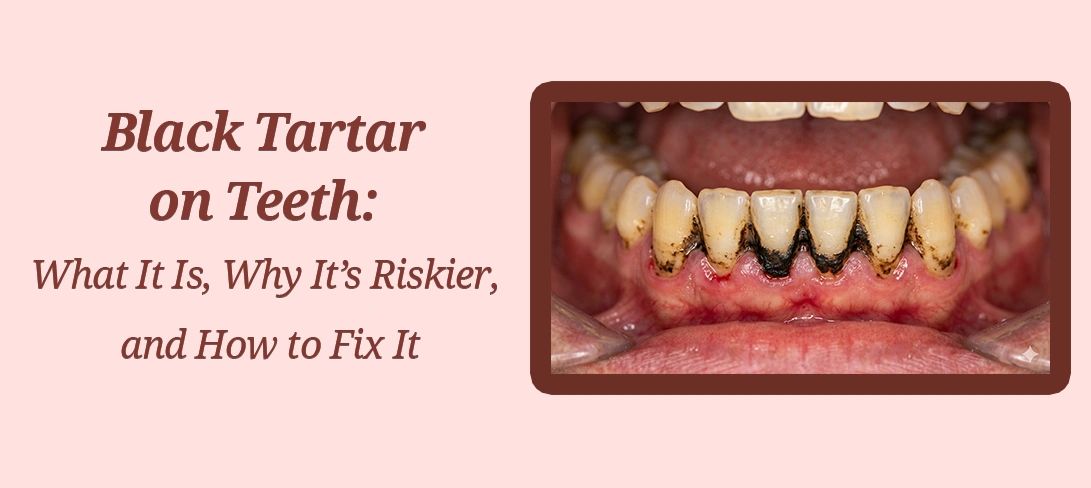
Black Tartar on Teeth: What It Is, Why It’s Riskier, and How to Fix It

Medically Reviewed By Clove Dental Team
Written By
Dr. Shreya Singh
Last Updated 08 June 2026
Introduction
If you’ve noticed a dark, almost black hard mass lurking along your gum line or hiding behind your lower teeth, it’s completely normal to feel a sudden spike of panic.
Regular tartar? We’re all used to seeing that slight yellowish tint. But black tartar looks completely different and even more concerning.
Here’s the good news: while it definitely means your gums are asking for urgent help, it is entirely treatable. Let’s break down exactly what’s going on in your mouth, why it happens, and how to clear it up safely, without panic.
What is Black Tartar?
To understand black tartar, we have to look at how it starts. Every day, a soft, sticky film of bacteria called plaque forms on our teeth. If we don’t brush or floss it away in time, the minerals in our saliva literally bake it into place. It hardens into a rock-like deposit called tartar (or dental calculus). Once it reaches this stage, your regular toothbrush won’t even scratch the surface.
So, why does it turn black?
It all comes down to location. Regular tartar sits above the gumline. But when tartar is left to sit for too long, it starts creeping under the gums into the tight pockets between your teeth and gum tissue. Down there, it constantly irritates the gums, causing them to bleed. The tartar absorbs the pigments from that blood, turning a dark brown, greenish-black color.
The takeaway: The black color isn’t just a bad stain from your morning coffee, it’s a clear warning sign that the buildup has gone deep enough to cause an active infection under your gums.
What Causes Tartar to Become Black?
While bleeding gums are the primary culprit, a few different factors can accelerate this process or make the discoloration much worse:
- Subgingival Calculus:
Tartar does not always stay where you can see it. When it is not removed in time, it slowly builds up below the gumline, into the narrow space between the tooth and the gum. Down there, it comes into contact with blood from irritated gum tissue. That contact is what turns it black. The deeper the tartar goes, the darker it gets. - Bleeding Gums:
Healthy gums do not bleed. If yours do while brushing, flossing, or even on their own, it means bacteria have been sitting at the gumline long enough to cause inflammation. That blood mixes with the tartar already sitting below the gumline and darkens it further. The tartar causes the bleeding. The bleeding darkens the tartar. One drives the other. - Tobacco Use:
Whether you smoke or chew tobacco, it acts like a turbo-charger for tartar. Not only do tobacco tars heavily stain the buildup, but nicotine also restricts blood flow to your gums. This compromises your body’s ability to fight off the underlying infection. - Dietary Stains:
If you already have porous tartar buildup under your gums, heavy consumption of black coffee, dark teas, and red wine will seep into it, making it look even darker. - Old Dental Work:
Sometimes, old silver or metal fillings can leach color near the gumline, mimicking the look of black tartar. A quick dental exam can easily tell the difference.
Is Black Tartar Dangerous? (The Health Risks)
Because black tartar lives beneath the surface, it does far more damage than regular yellow tartar. It isn’t a cosmetic issue; it’s a clinical one.
1. It Drives Advanced Gum Disease (Periodontitis):
Early gum disease (gingivitis) makes your gums red and swollen, but it’s completely reversible. However, if black tartar keeps trapping bacteria deep in the gum pockets, it transitions into periodontitis. This is where the damage becomes permanent.
2. Silent Bone Loss:
As the body tries to fight off the bacteria trapped by the tartar, the infection slowly eats away at the bone holding your teeth in place. The scariest part? This usually happens silently with zero pain, until your teeth suddenly start feeling loose.
3. Stubborn Bad Breath:
No amount of mints, mouthwash, or aggressive brushing will fix the bad breath caused by black tartar. The foul-smelling gases are being produced by bacteria trapped deep under the gumline, completely out of reach of your home care routine.
4. Hidden Decay and Systemic Risks:
Tartar has a rough, sponge-like texture that acts as a magnet for more plaque and acid, accelerating cavities right at the root of the tooth. Furthermore, severe gum infections allow bacteria to enter your bloodstream, which medical research has linked to heart complications and difficulties managing blood sugar in diabetics.
Black Tartar vs. Yellow Tartar: A Quick Glance
| Feature | Yellow Tartar | Black Tartar |
|---|---|---|
| Where it can be found | Above the gumline (visible) | Deep below the gumline (hidden) |
| Why it changed color | Normal mineral buildup & food | Blood pigments from inflamed gums |
| What it means | Early plaque buildup / mild gingivitis | Active gum disease / periodontitis |
| How to fix it | Routine scaling and polishing | Deep scaling & root planing |
| Urgency | Mention it at your next check-up | Needs prompt professional care |
Can You Remove Black Tartar at Home?
Internet nowadays is flooded with DIY teeth cleaning hacks that involve baking soda, apple cider vinegar, oil pulling methods, and sometimes making your own toothpaste at home. Many of these claim to have results similar or even better than professional cleaning. What people fail to realise is that DIY teeth cleaning methods are unsupervised and can lead to permanent enamel damage if not undertaken correctly.
While these might work for plaque in certain cases, its use is always recommended with caution. When talking about black tartar, please avoid these. Because black tartar is calcified and literally bonded to the root of your tooth beneath the gum line, home remedies cannot dissolve it.
Trying to scrape it yourself is incredibly dangerous. You risk cutting your sensitive gum tissue, scratching your protective enamel, or accidentally pushing the bacteria even deeper into the socket, turning a mild issue into a painful abscess.
What Happens During Professional Tartar Removal?
Clearing out black tartar requires a bit more care than a standard 15-minute cleaning. Dentists use a highly effective process called Deep Scaling and Root Planing. Here is what to expect:
- The Assessment:
Your dentist will firstly do a clinical examination, to check for pockets and assess the extent of tartar deposition. This is followed by a quick x-ray to understand the effect of the same on bone structures. - Ultrasonic Cleaning:
With the use of modern ultrasonic scalers, hard tartar deposit is broken down effortlessly with the help of high-frequency vibrations. This process takes place along with a continuous micro-spray of water, that simultaneously cools the area and flushes out the debris. - Root Planing:
When the tartar formation has gone too deep affecting the roots as well, an additional procedure called root planing is undertaken. The dentist will carefully smoothen out the affected root surface, removing any deposits, so that it is easier for the gums to heal and reattach itself at the right position. - The Schedule:
If there is a significant amount of buildup, your dentist might break the treatment down into two to four short sessions (focusing on one quarter of your mouth at a time) to ensure you stay completely comfortable.
Note on comfort: Gums can be sensitive when they are inflamed, so your dentist will happily use a numbing gel or a local anesthetic. You won’t feel a thing during the process, and any minor post-cleaning soreness usually fades in a couple of days.
How to Prevent Black Tartar From Forming: Prevention
Once your dentist clears out the deep buildup, you get a fresh start. To keep your gums healthy and prevent black tartar from returning, focus on these simple habits:
- Use the Correct Brushing Technique:
Brush twice a day for two full minutes, but tilt your brush at a 45-degree angle right where your teeth meet your gums. That’s where plaque loves to gather. - Commit to the Floss:
Brushing misses the tight spaces between your teeth. Daily flossing or using an interdental brush cuts off the plaque before it has a chance to calcify. - Step Up the Check-ups: If you are prone to deep buildup, visiting your dentist every 3 to 4 months for a quick cleanup (instead of waiting a full year) will keep your gum pockets tight and healthy.
- Ditch the Tobacco: Giving up smoking or chewing tobacco is the single best favor you can do for your mouth. It restores healthy blood flow to your gums, allowing them to heal properly.
FAQs
- Q1. Is black tartar a sign of an underlying disease?
- A1. Not directly, but it is a definitive sign of advanced gum disease. Because oral health is deeply connected to your heart and metabolic health, it’s something you want to get sorted out sooner rather than later.
- Q1. Will my teeth look different after it’s gone?
- A1. Once the tartar is removed and the infection clears up, your swollen gums will shrink back down to their healthy, normal size. Because of this, you might notice slightly larger gaps between your teeth near the gumline. This is completely normal and a sign that your gums are finally healing.
- Q1. Can it come back?
- A1. Yes. Professional cleaning clears the slate, but if old brushing habits stick around, plaque will start hardening into tartar all over again within weeks.
Conclusion:
Ignoring black tartar won’t make it go away, but a single visit to a professional can stop the damage right in its tracks.
Don’t wait for discomfort or loose teeth to tell you there’s a problem. Book a deep scaling and periodontal assessment at Clove Dental today, and let our specialists restore your gums to perfect health.
Leave a Reply
Leave a Reply
Expert Guidance for Healthy Smiles
Book your free consultation today and take the first step towards healthy, beautiful teeth.

Membership Plans
Special thanks to our 30 Lakh valued customers
Dental Health
Plan Premium
Buy and Get Benefits at
590/-
in dental Treatments
Explore More Similar Posts
Explore More Blogs


Leave a Reply